No service running/ Current step: Fleet operator selection

Where things stand

NWABentonville · Rogers · Springdale · Fayetteville · XNA

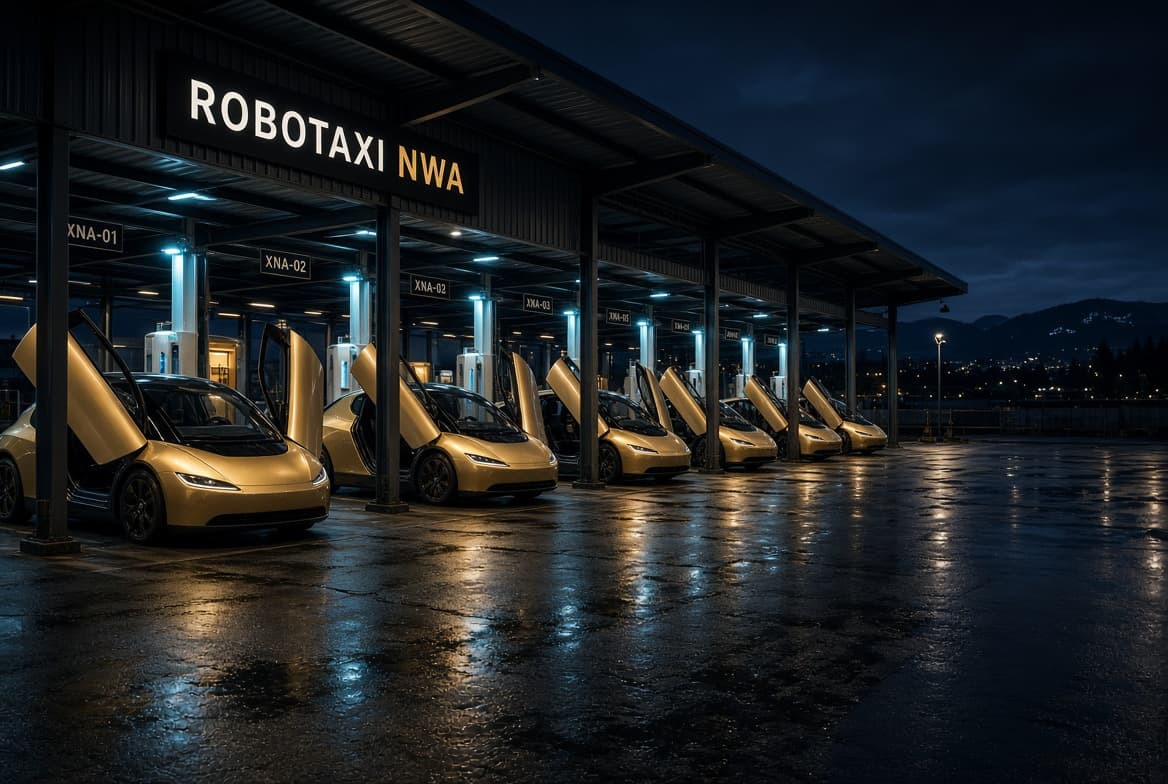
Driverless is coming to Northwest Arkansas. We’re building the depot it lands in.

Tesla put a two-seat, steering-wheel-less cab into paid service in Austin on 3 September 2026, and the same day asked which businesses want to run fleets of them. We applied for this market. Nothing is operating here yet — not ours, not anyone’s — and this site will keep saying so until that changes.

Occasional updates on the vehicle, the state process and this market. No fares, no projections, no pitch.

Service today
NoneNothing is bookable. This site is ahead of the service.
The vehicle
CybercabTwo seats, no steering wheel, no side mirrors, 48 kWh
The state gate
§ 27-51-2002Arkansas AV program, State Highway Commission
Supervised period
6 monthsOperator required in the vehicle before driverless

01 — What is actually known

6 things that are true about the Cybercab today.

All of it from public reporting, none of it from a conversation with Tesla. Verified 6 October 2026 — if you are reading this much later, check it again.

  1. 01

    Cybercab is carrying paying riders

    Tesla launched it in Austin on 3 September 2026 and paid rides began the next day. It is a real vehicle on real roads, not a concept — but it is geofenced to Austin, and Tesla named no second city and gave no expansion calendar.

  2. 02

    It is a two-seater with no controls

    No steering wheel, no pedals, no side mirrors. 48 kWh, around 219 hp, roughly 293 miles of range, a consumer target price under $30,000 and a stated operating-cost target under $0.30 a mile.

  3. 03

    It charges by cable today, and pads are a later promise

    The production car has a NACS port and DC fast charges at Superchargers. It has no onboard AC charger, so there is no Level 2 and no wall connector. Inductive charging has been demonstrated at 19–25 kW and is described as a planned fleet feature — a depot needs the cable now and the pads later.

  4. 04

    Volume production is not this year

    Tesla removed Cybercab from its 2026 volume-production list six weeks before the Austin launch. About 45 were registered for commercial use at launch; by early October that was 169 in Austin, and NHTSA puts the US population at about 1,000. Its chief engineer told regulators to expect roughly 2,500 vehicles within the year.

  5. 05

    Federal regulators are auditing whether it is legal to sell

    NHTSA opened audit query AQ26002 the day paid rides started, covering about 1,000 vehicles, then escalated on 10 September to a special order: 21 questions a Tesla officer had to answer under oath by 30 September 2026. It asks how a car with no brake pedal meets a rule requiring service brakes be foot-operated, and whether temporary driver controls were fitted for the certification tests. Tesla holds no Part 555 exemption. The deadline has passed and neither Tesla nor NHTSA has said whether answers were filed or more time was granted. No recall, suspension or operating ban has been issued, and Austin service continues.

  6. 06

    Tesla is asking who wants to run fleets

    On 3 September 2026 Tesla published an interest form with four options — fleet vehicle purchasing, mobility hubs and infrastructure, event collaboration, other — and a field for your region. We submitted Northwest Arkansas.

02 — What nobody knows yet

The honest version of the part everyone else turns into a spreadsheet.

Other regional sites fill this space with projected returns per vehicle. Those numbers are built on a take rate Tesla has never published. Here is the actual state of the information.

Whether fleets will be sold at all
An interest form is not a sales program. Tesla has announced no third-party partnership and has said nothing about who qualifies — and until the federal certification question is settled, whether the vehicle can lawfully be sold to anyone is itself open.
Vehicle price to an operator
The sub-$30,000 figure is a consumer target, not an operator quote. No fleet pricing exists.
The network split
What share of a fare an operator keeps is unpublished. Every regional site quoting a return has picked a number and called it an assumption.
Operating requirements
No published standard for what a fleet operator must provide — depot, staffing, response times, insurance minimums. All of it is still to come.
What depot charging actually is
Superchargers are a known quantity and are not ours to install. Tesla has published no inductive pad hardware, price, power level or availability date, so the pad half of the depot has no number behind it.
Selection and market timing
Tesla has not said when markets are chosen, announced, or opened. Northwest Arkansas is not on any published map.
Arkansas approval timing
No published processing time for an autonomous vehicle program application under A.C.A. § 27-51-2002.
03 — Where a local operator fits

The manufacturer keeps the software. Somebody local keeps the cars running.

Waymo–Uber in Austin and Atlanta. Waymo–Lyft in Nashville. Avis in Dallas. Hertz for Uber in San Francisco. Four independent deals, one shape — and the right-hand column is a real operating business with staff, a building, and a phone that gets answered at 3am.

The manufacturer keeps

  • The vehicle and its software
  • Remote assistance and teleoperation
  • The rider app and rider support
  • Event response for crashes and safety
  • Roadside assistance

The local operator owns

  • The depot and the ground it sits on
  • Charging, staging and turnaround
  • Cleaning and readiness between rides
  • Inspections, tires, wear and damage
  • Being reachable when a car stops in a lane

This is the work we are building toward. None of it requires permission to start thinking about, and all of it is what an operator gets judged on.

04 — How we intend to run it

Commitments, stated before there is anything to test them against.

Written down now, in public, so they can be held against us later.

A depot built for this vehicle

The production Cybercab charges by cable — a NACS port, DC only, with no onboard AC charger and so no Level 2 to fall back on. Inductive pads are a stated plan, not shipped hardware. So the depot gets built for the cable that exists and laid out for the pads that are promised, rather than costed on a 2024 render.

Cleaning treated as a real job

Waymo escalates cleaning to a dedicated role and treats biohazard work as routine rather than exceptional. Two to three cleaning and charging cycles per vehicle per day is the published shape of this work. We intend to staff it that way from the first car.

A responder line that is answered

A vehicle with no steering wheel that stops in a travel lane cannot be pushed aside by a fire crew. Scene-clearance time is becoming a procurement question for AV fleets. Our responder page is published before we have a single vehicle, because local agencies should have it before they need it.

Local jobs, not eliminated ones

Autonomous fleets still need charging, cleaning, inspection and incident response, staffed by people who live here. Those are the roles this operation would hire for in Northwest Arkansas.